
Cold Email in 2026: What the Data Says About Volume, Warmup, Bounces and Spintax
Every number in this guide comes from a 2026 source: Microsoft's tenant sending limits, the Hunter and Instantly benchmark reports, warmup schedules, bounce thresholds, catch-all data and spintax rules, each one cited.
Updated November 24, 2026 · Prices checked November 2026 · By the WhaleScale team
This guide doesn't give you opinions. It collects what Microsoft, the big 2026 benchmark reports and the sending platforms have published this year about volume, warmup, bounces, follow-ups and spintax. Every number has its source named next to it. Where we describe how WhaleScale runs things, we say so.
What the 2026 sources agree on
- Microsoft meters external recipients across the whole tenant, and a new tenant gets 10% of its limit for its first 30 days (MC1454397).
- Volume: about 100 a day is the safe ceiling for a warmed inbox (MailReach). Reply rates peak at 20 to 49 sends a day per campaign (Hunter).
- Warmup: two weeks minimum, three to four is common, and keep it running (Salesforge, TrulyInbox).
- Bounces: under 2% total and under 1% hard. Stop above 5% (Apollo).
- Sequences: three emails double replies over one (Hunter). Over half of meetings come from step 3 or later (Belkins).
- Spintax: 2 to 4 options per group, at phrase level (Woodpecker). A few hundred combinations covers a normal campaign (Emailchaser).
Microsoft's tenant limit, from Microsoft
If you send from Microsoft 365, this is the hard ceiling. According to Microsoft's message center notice MC1454397, Exchange Online caps external recipients per tenant in a rolling 24 hours, using this formula:
500 x (number of licenses ^ 0.7) + 9,500 external recipients per 24 hours.
The same notice sets lower limits for new and trial tenants:
| Tenant age | Share of the limit | Single-license tenant |
|---|---|---|
| Days 1 to 30 | 10% | 1,000 a day |
| Days 31 to 60 | 25% | 2,500 a day |
| Day 61 onward | 100% | 10,000 a day |
| Trial tenant | Fixed | 500 a day |
Single-license figures are the formula worked through: 500 x 1 + 9,500 = 10,000. Messages over the limit bounce with 550 5.7.233, per MC1454397.
The cap counts every external recipient the tenant sends to, so warmup emails come out of the same budget as cold ones. Microsoft also planned a separate cap of 2,000 external recipients per mailbox. In January 2026 the Exchange Team announced it was cancelling that plan, and The Register reported the same. The existing 10,000 recipients a day per mailbox still applies.
How WhaleScale sizes tenants around it
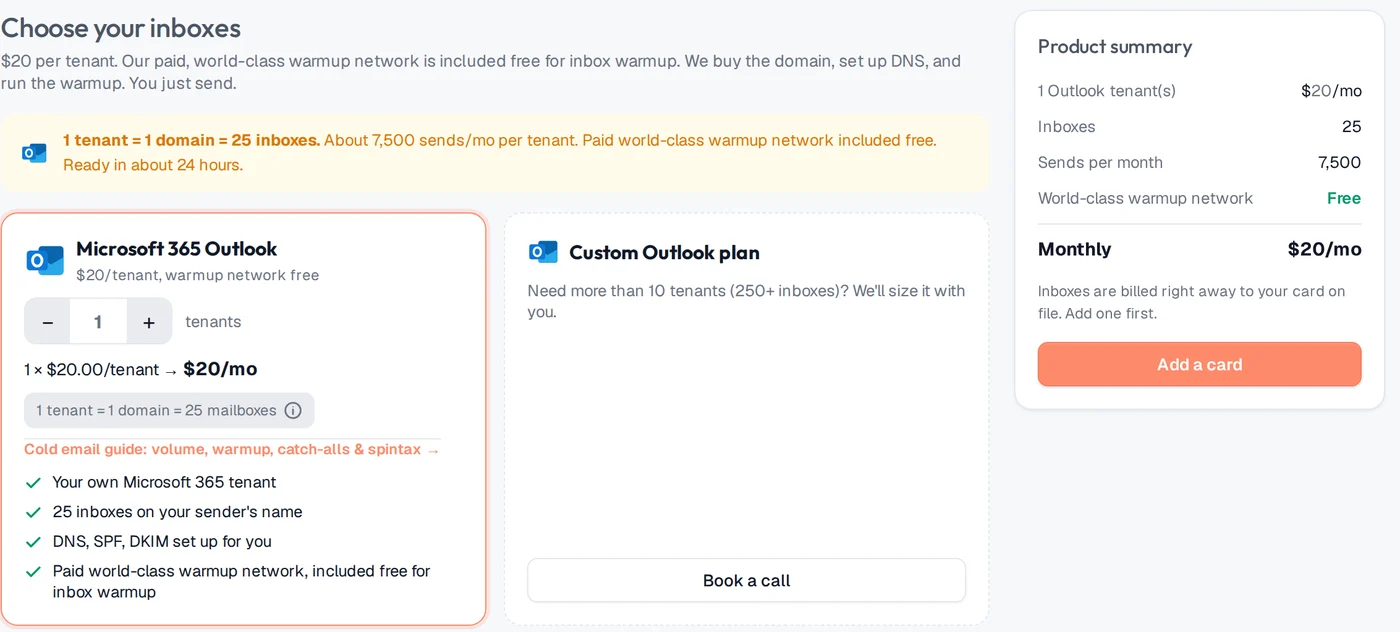
This part is our own setup, not research. We put 25 inboxes on each tenant and ramp each inbox from 1 to 10 cold sends a day. At full speed that's 250 cold sends a day per tenant, about 7,500 a month. That stays well under the 1,000 a day a new tenant gets in its first 30 days, and it leaves room for warmup traffic. For more volume, we add tenants, not inboxes.
How many emails to send per day
The 2026 sources look at volume two ways: what an inbox can safely send, and what volume gets the best replies.
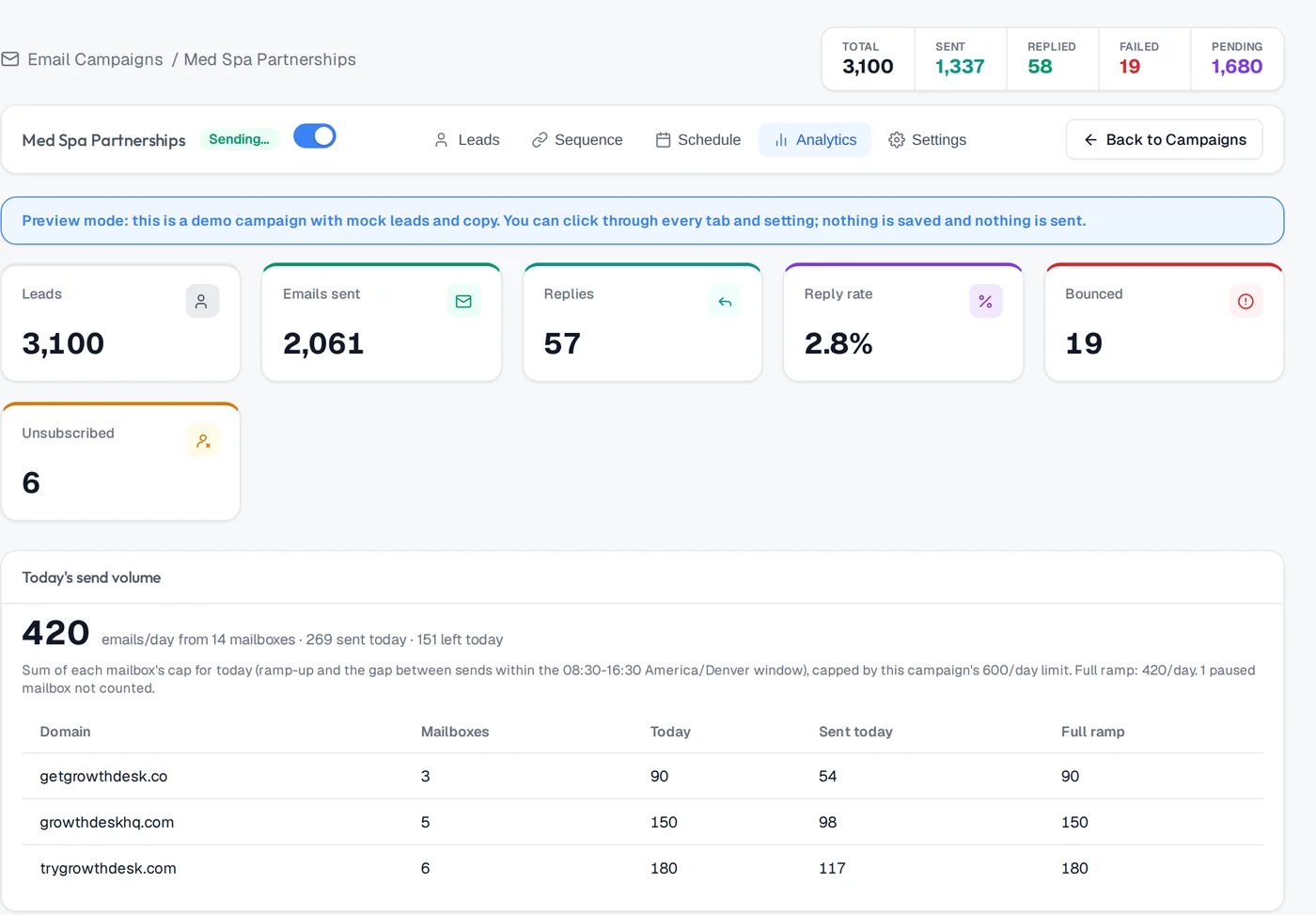
- Per inbox: MailReach (February 2026) puts the safe limit at about 100 emails a day for a fully warmed inbox, starting around 20 a day in week one. It also says warmup should stay at at least 15% of total volume.
- Per campaign: Hunter's State of Email Outreach 2026 analysed 31 million emails. It found reply rates peak at 5.7% when a campaign sends 20 to 49 emails a day, 27% above the 4.5% average. Hunter's conclusion: "human-like sending volumes protect deliverability."
- New domains: Instantly's Cold Email Benchmark Report 2026 recommends starting new domains at 5 to 10 emails a day and raising that over 4 to 6 weeks.
Warmup
The 2026 sources agree on two weeks as the minimum. They differ on how long beyond that.
- Salesforge (August 2026) calls two weeks the floor and says many operators run three to four. It advises never switching warmup fully off.
- TrulyInbox (August 2026) recommends four weeks from the first warmup email to the first cold one, and never raising volume by more than about 20% a day.
TrulyInbox's week-by-week schedule:
| Week | Emails per inbox per day |
|---|---|
| Week 1 | 5 to 10 |
| Week 2 | 15 to 25 |
| Week 3 | 30 to 50 |
| Week 4 | 50 to 60 |
| Week 5 onward | Keep 15 to 20 warmup emails running alongside cold sends |
Source: TrulyInbox, August 2026.
List cleaning, bounces and catch-alls
Bounce rate is the number every 2026 source tells you to watch first. Their thresholds:
| Bounce rate | Apollo (Apr 2026) | Amplemarket (Jun 2026) |
|---|---|---|
| Under 1% | Healthy. Hard bounces should stay here. | Best is under 1.5% |
| 1% to 2% | Acceptable. Keep total bounces under 2%. | Good is under 3% |
| 2% to 5% | Pause and re-verify the list | Slow down above 3% |
| Over 5% | Stop sending | Stop sending |
Apollo also recommends a seed test: send a small slice of the list first, and if hard bounces come back above 2%, don't send the rest. Amplemarket adds a second number to watch: keep spam complaints under 0.3%.
Catch-all domains
A catch-all domain accepts mail for any address, so a verifier can't confirm whether a person exists there. ReplyLead (September 2026) checked 569,984 business addresses. It found 45.5% of Google Workspace addresses were catch-all, compared with 6.7% of Microsoft 365 addresses. If your list skews toward Google Workspace companies, expect a large unverifiable segment. Apollo's seed-test rule is the safest way to send to it: test a slice first and hold the rest if hard bounces pass 2%.
Sequences: how many follow-ups, and when
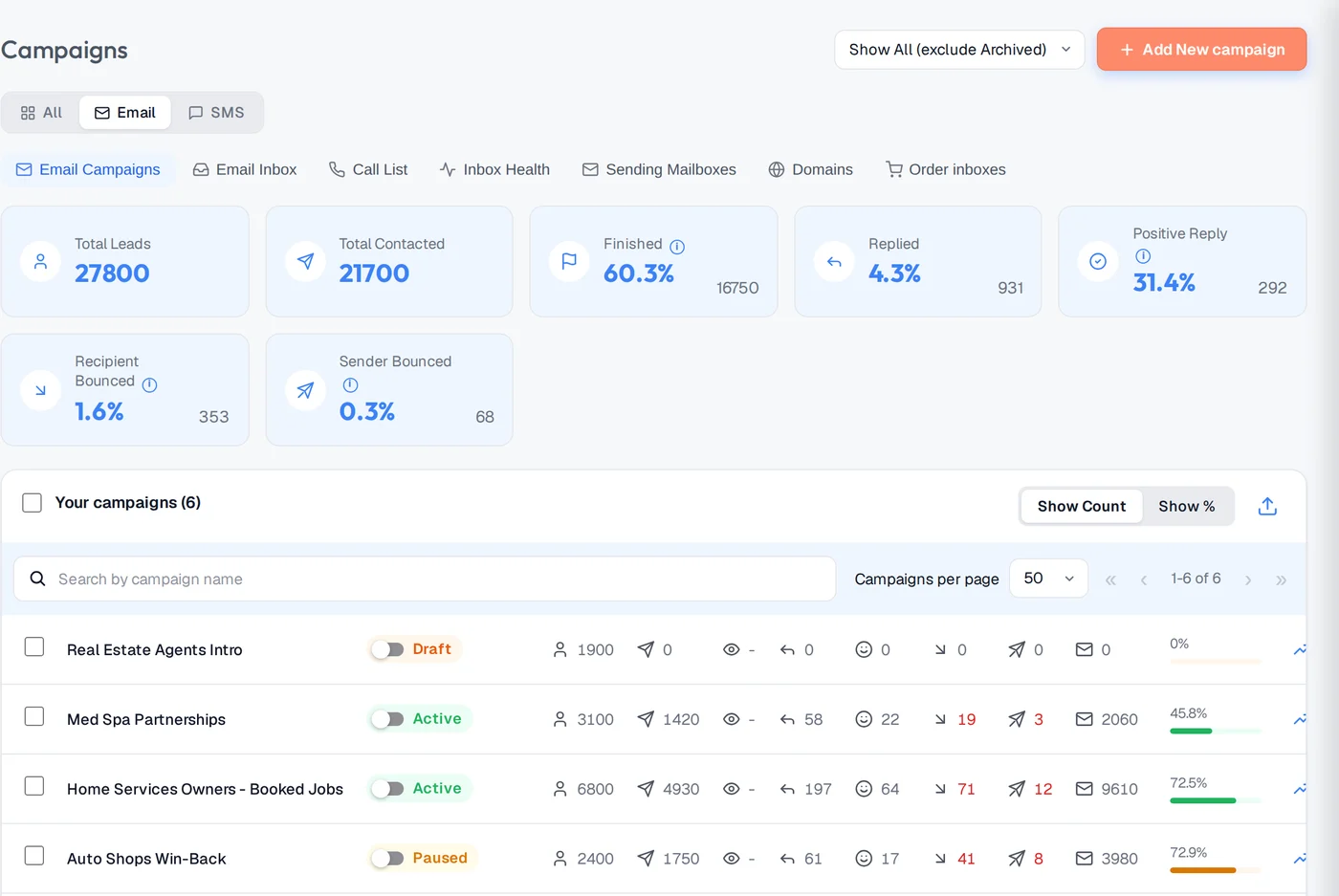
- Three emails beat one. Hunter's 2026 report found three messages get 106% more replies than a single email (6.8% vs 3.3%) and calls "three total emails" the optimal balance.
- Most replies come early. Instantly's 2026 benchmark found 58% of replies come from step 1. It recommends 4 to 7 touchpoints spaced 3 to 4 days apart.
- Most meetings come later. Belkins (June 2026) recommends 3 to 5 steps and found over 53% of meetings come from step 3 or later.
What a good reply rate looks like
Instantly's Cold Email Benchmark Report 2026 puts the average reply rate at 3.43%. The top quartile reaches 5.5%, and top performers pass 10%. Hunter's dataset averages 4.5%.
Copy: one base email per 1,000 leads, spintaxed
WhaleScale's rule, set by our team: write one base email for every 1,000 leads and spintax it. Spintax combinations don't count as separate variations. A 3,000-lead campaign gets three base emails, each one spun.
Spintax swaps in a different phrase for each recipient, so the same base email doesn't go out word for word. Here is what the 2026 sources say about doing it well:
- 2 to 4 options per group, spun at the phrase level, not single words (Woodpecker, May 2026).
- Keep merge fields outside the spin groups. Woodpecker also warns that over-spinning creates patterns filters can match.
- A few hundred combinations covers a normal campaign. Ideally you have more unique combinations than recipients. 50 clean variations beat 5,000 sloppy ones, and 1 to 2 levels of nesting is plenty (Emailchaser, August 2026).
- Preview before launch so you can catch broken braces or awkward combinations (Instantly Help Center, October 2026).
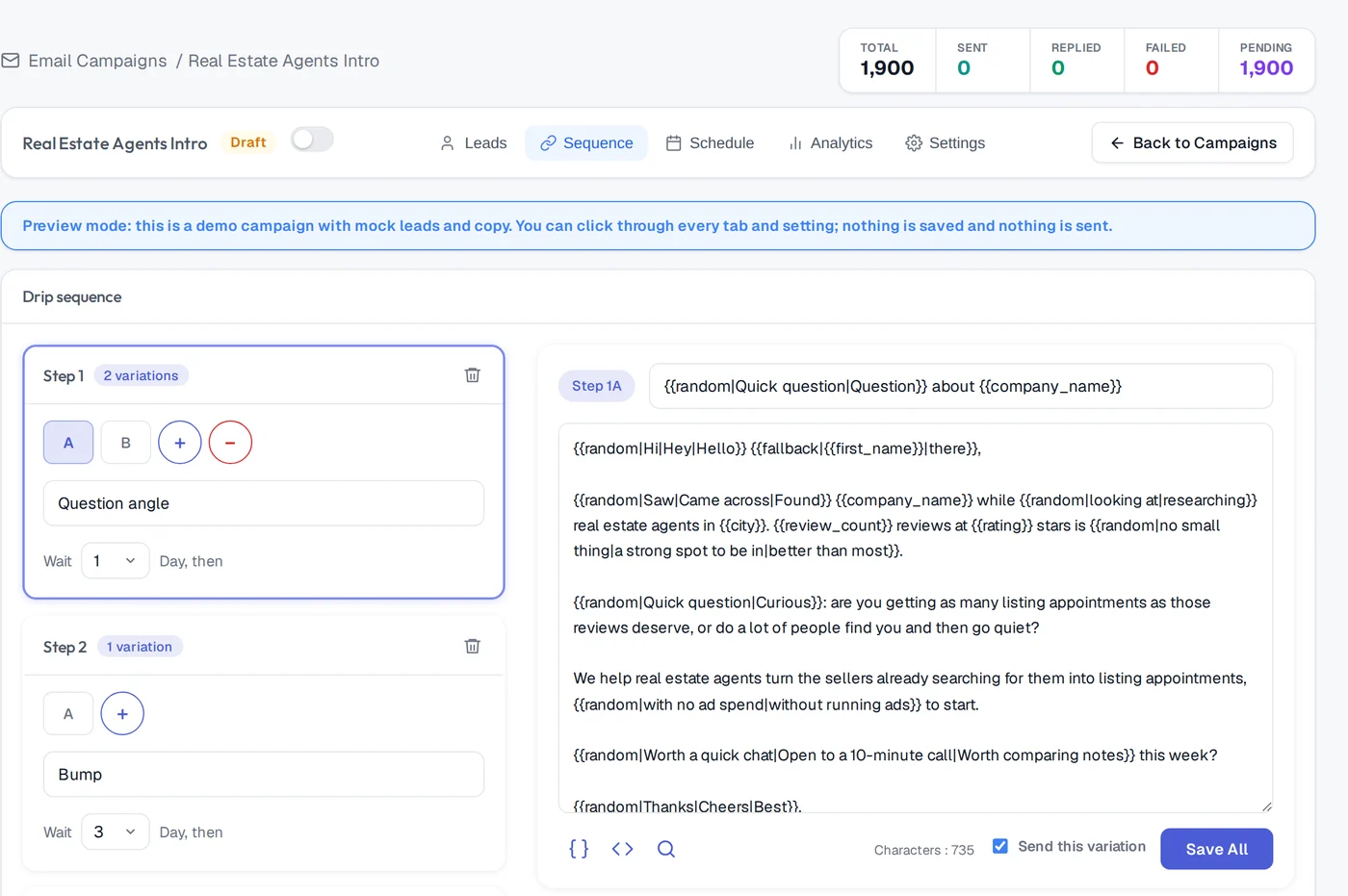
What that looks like in WhaleScale's syntax, with 3 options in each of 4 groups (81 combinations from one base email):
{{random|Hi|Hey|Hello}} {{fallback|{{first_name}}|there}},
{{random|I noticed|I came across|I was looking at}} {{company_name}} {{random|while researching|while looking into|while reading about}} businesses in {{city}}.
{{random|Worth a quick chat?|Open to a short call?|Would a 10-minute call make sense?}}
How WhaleScale puts this together
WhaleScale sets up Microsoft 365 tenants with 25 inboxes each, ramps every inbox from 1 to 10 cold sends a day and tracks bounces per campaign, so the thresholds above are easy to watch. The full setup is on the inboxes page.
Frequently asked questions
How many cold emails can one inbox send per day in 2026?+
MailReach (February 2026) puts the safe limit at about 100 emails a day for a fully warmed inbox, starting around 20 a day in the first week. Hunter's State of Email Outreach 2026, built on 31 million emails, found reply rates peak at 5.7% when a campaign sends 20 to 49 emails a day.
What is Microsoft's tenant external recipient limit?+
Per Microsoft's message center notice MC1454397, the tenant limit is 500 x (licenses ^ 0.7) + 9,500 external recipients per rolling 24 hours. New tenants get 10% of that for days 1 to 30 and 25% for days 31 to 60. Trial tenants get 500. Going over returns 550 5.7.233.
How long should I warm up a new inbox?+
Salesforge (August 2026) calls two weeks the floor, with many operators using three to four. TrulyInbox (August 2026) recommends four weeks from the first warmup email to the first cold one and never raising volume by more than about 20% a day.
What bounce rate is too high for cold email?+
Apollo (April 2026) says keep total bounces under 2% and hard bounces under 1%, pause and re-verify between 2% and 5%, and stop above 5%. Amplemarket (June 2026) calls under 3% good and under 1.5% best.
How many follow-ups should a cold email sequence have?+
Hunter's 2026 report found three emails get 106% more replies than one (6.8% vs 3.3%). Instantly's 2026 benchmark recommends 4 to 7 touchpoints spaced 3 to 4 days apart, and Belkins (June 2026) found over 53% of meetings come from step 3 or later.
How many email variations do I need per 1,000 leads?+
WhaleScale's rule is one base email per 1,000 leads, spintaxed. Spintax combinations don't count as extra variations. For the spintax itself, Woodpecker (May 2026) recommends 2 to 4 options per group, and Emailchaser (2026) says a few hundred combinations covers a normal campaign.
Sources
- Microsoft 365 Message Center, MC1454397 (tenant external recipient rate limit)
- Microsoft Exchange Team, Exchange Online canceling the Mailbox External Recipient Rate Limit (Jan 2026)
- The Register, Microsoft drops Exchange Online recipient rate limit plan (Jan 2026)
- Hunter, The State of Email Outreach 2026
- Instantly, Cold Email Benchmark Report 2026 (Jan 2026)
- MailReach, How many cold emails to send per day (Feb 2026)
- TrulyInbox, How to warm up an email domain (Aug 2026)
- Salesforge, Email warm-up (Aug 2026)
- Belkins, Sales follow-up statistics 2026 (Jun 2026)
- Apollo, Bounce rate benchmarks with a paid data provider (Apr 2026)
- Amplemarket, Cold email benchmarks (Jun 2026)
- ReplyLead, Cold email statistics (Sep 2026)
- Emailchaser, Spintax guide (Aug 2026)
- Woodpecker, Spintax for cold email (May 2026)
- Instantly Help Center, How to use spintax (Oct 2026)
Competitor prices come from their public pricing pages as of November 2026 and change often, so check the vendor before you buy. Product names belong to their owners; WhaleScale isn't affiliated with them.